Implant surgery, crowns and full-arch rebuilding at a large dental practice in Chongqing, built for implant work rather than adapted to it. Every quote is itemised — implant, abutment, crown, grafting, surgery — with nothing bundled to hide a margin.
Two visits, 30–45 days apart · Itemised quote before any surgery
Cancer treatment, cardiac surgery and complex internal medicine all carry clinical variables a coordinator cannot responsibly simplify. Restorative dentistry is different: the materials are standardised internationally, the procedure is well-defined, and the price difference is genuine and verifiable.
Straumann, Nobel Biocare, Osstem — the systems used in London, Sydney and Toronto are the same systems used here. China's volume-based procurement programme cut implant material costs by roughly 55% nationally, and public hospitals sell them at zero markup.
In several countries a routine implant sits behind a months-long referral queue. Here, once your scans are reviewed, surgery can usually be scheduled within weeks rather than quarters.
CBCT imaging, intraoral scanning and guided surgical planning are standard in the department. You receive the scan data, not just a verbal opinion.
A single implant saves a meaningful amount. A full-arch case — where grafting, multiple fixtures and a full prosthesis are involved — is where the difference becomes large enough to justify the flight.
What we will not claim. We do not say Chinese dentistry is better than dentistry anywhere else. It is not. What we say is that this department uses internationally standardised implant systems, performs the procedures routinely, and prices them far below Western private practice — and that we will show you the itemised quote before you commit to anything.
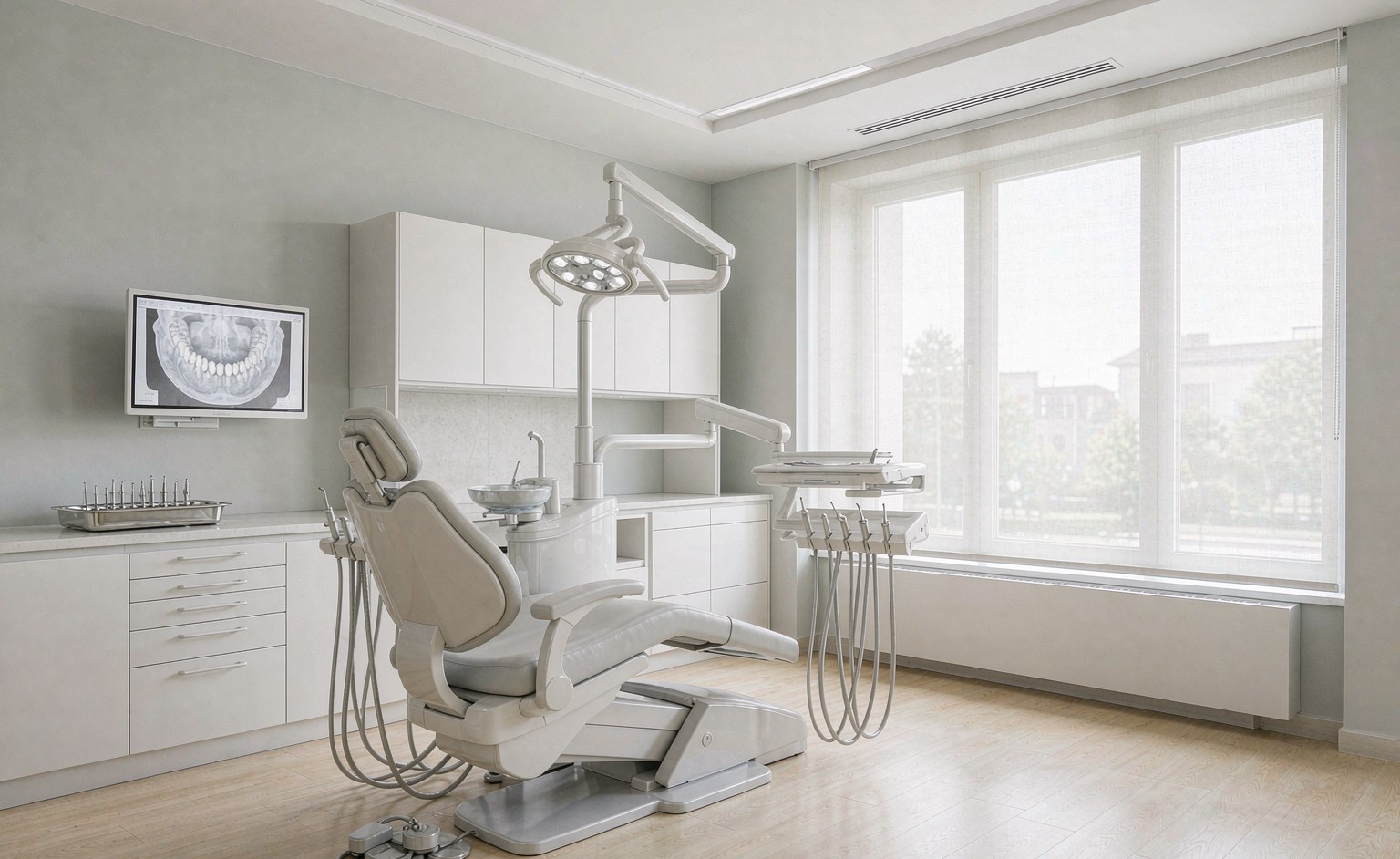
We work with a large dedicated dental practice in Chongqing, set up for implant surgery rather than a general clinic that also places implants. Dedicated implant suite, CBCT in the building, and prosthetics produced on a clinical timescale through a laboratory arrangement the practice controls.
That last point is what makes a two-visit schedule honest: the permanent crown or bridge is made during the 30 to 45 days you are at home, not rushed inside a single week. We will confirm the specific practice, its equipment list and the surgeons who would handle your case in your written quote — before you commit to anything.
Ranges below reflect pricing under China's national procurement programme for implant materials, compared with typical private fees in three common source markets. Final figures depend on bone condition, implant brand and prosthesis type — all confirmed after your scans are reviewed.
| Procedure | China (Chongqing) | United Kingdom | Australia | United States |
|---|---|---|---|---|
| Single implant + abutment + crown | ¥4,500–7,500 ≈ US$630–1,050 |
£2,500–3,500 | A$4,000–6,000 | $4,500–6,500 |
| Single implant — premium brand Straumann / Nobel |
¥7,500–10,500 ≈ US$1,050–1,470 |
£3,500–5,000 | A$5,000–7,500 | $5,500–7,500 |
| All-on-4, per arch | ¥55,000–100,000 ≈ US$7,700–14,000 |
£14,000–22,000 | A$22,000–32,000 | $22,000–30,000 |
| All-on-6, per arch | ¥80,000–130,000 ≈ US$11,200–18,200 |
£18,000–28,000 | A$28,000–40,000 | $28,000–38,000 |
| Bone graft, per site | ¥2,000–5,500 | £600–1,500 | A$800–2,200 | $800–2,000 |
| Sinus lift | ¥4,000–8,500 | £1,500–2,800 | A$2,000–4,000 | $1,800–3,500 |
| Zirconia crown | ¥1,600–3,000 | £500–1,000 | A$1,000–1,800 | $800–1,500 |
| Root canal treatment | ¥1,200–3,000 | £600–1,400 | A$1,000–2,200 | $1,200–2,500 |
| CBCT 3D scan | ¥200–500 | £150–350 | A$250–600 | $250–600 |
Conversion at approximately ¥7.15 to US$1. Home-market ranges are indicative private-practice figures compiled from published 2026 market data and vary by city, practitioner and case complexity. Implant material pricing at public hospitals in China is governed by the national volume-based procurement programme and sold at zero markup; surgical service fees are subject to provincial caps. All figures are indicative and are superseded by the written quote for your specific case.
Most medical-travel sites leave their own fee out of the website entirely. We publish ours, because you should be able to calculate your total before you make contact — not after.
| Service | What is included | Fee |
|---|---|---|
| Initial case review | Review of your scans or treatment history, a written estimate, and a recommendation on whether travelling is worth it for your case. | Free |
| Remote consultation coordination | Scheduling a video or written consultation with the department, translating the question and the answer. | Free |
| Treatment coordination — dental | Appointment booking, case liaison with the department, interpreting during consultations and surgery, sequencing across your trip. | ¥3,800 per case |
| Treatment coordination — screening | Screening slot booking, package selection, on-site accompaniment, translated report delivery. | ¥1,800 per person |
| Combined dental + screening | Both of the above, with the screening day built into the first trip. | ¥4,800 per case |
| Arrival support | Airport transfer, hotel check-in assistance, hospital registration on your first day. | ¥900 |
| Medical visa invitation letter | Preparing and issuing the clinic's invitation letter and supporting documents. | ¥600 |
| Interpreting — additional days | Beyond the days included in treatment coordination, billed per half-day. | ¥450 / half-day |
What the fee does not cover. Hospital charges, implant materials, laboratory work, medication, accommodation, flights and travel insurance are all paid separately and directly to the relevant provider. You will see the clinic's own itemised bill — we do not take a margin on clinical charges, and we do not receive commission from the practice for steering you toward a particular treatment.
Implant dentistry has a biological limit no clinic can engineer around: the titanium fixture must fuse with bone before it can carry a permanent crown. In the mandible that takes three to four months; in the maxilla, four to six. Anyone selling you a single round trip for a completed implant is either describing immediate loading — which suits a minority of cases — or misrepresenting the process.
CBCT and intraoral scan on arrival, a written plan and itemised quote the same or next day, then implant placement once you have agreed to it. Where the case allows, a temporary prosthesis is fitted so you are not without teeth for three months.
Extractions, bone grafting or a sinus lift, if your scan calls for them, happen here — and they change the schedule. Grafting adds its own healing interval of three to six months before the implant can even be placed.
ChongqingClinicThis is the part that determines your calendar. A 30-day interval is realistic for a straightforward mandibular case in good bone. Upper-jaw sites usually need 45 days or more, and grafting pushes it to three to six months.
You spend this interval at home. We stay in contact, relay any questions to the clinician, and hold your second appointment. Your local dentist can monitor the site if that is easier — we send them the records to do it.
At homeCoordinatorSecond-stage exposure, healing abutment, soft-tissue contouring, then scanning and fitting of the permanent prosthesis. Most cases need two to three days on site, with the laboratory work turned around in between.
Where the interval has been short and the tissue needs longer to contour, we may ask you to allow a fourth day rather than rush the fit.
ChongqingClinicYou leave with the implant system's documentation, including make and lot number, so any warranty claim can be made in your own country. Routine maintenance is done by your local dentist; we remain the contact if something needs escalating back to Chongqing.
At homeCoordinatorThe honest arithmetic. Two trips is the real cost of implant dentistry, and it is the cost at home too — the difference is that at home you wait in a queue between them, and here you wait on a train. Factor the second flight into your comparison. For a single implant, the fare can eat most of the saving. For a full-arch case it does not come close.
On "one-visit implants". Immediate-loading protocols are legitimate for selected cases — good bone quality, adequate primary stability, usually a single arch. They are not appropriate for every patient, and no clinic should promise them before seeing your scan. Even with immediate loading, the permanent prosthesis still waits for osseointegration.
Single and multiple implants, immediate implant placement after extraction, guided surgery, and full-arch rehabilitation on four or six fixtures.
Zirconia and lithium disilicate crowns, veneers, bridges, and removable or fixed prostheses — designed from intraoral scan data.
Fixed appliances and clear aligners for adults, including pre-restorative alignment before implant or prosthetic work.
Root canal treatment under magnification, retreatment of previously treated teeth, and post-and-core restoration.
Minimally invasive extraction, impacted wisdom teeth, bone grafting, and sinus floor elevation.
Scaling, root planing and periodontal maintenance — usually the necessary first step before any implant work.
Tell us how many teeth are involved and what you have been quoted at home. We will come back with a range based on the department's actual pricing — and tell you honestly if travelling would not be worth it for your case.